
The Sponsors of the ISPE’s Robotics & AI and RAYA Conference
- Post author:Jan Hübner
- Post published:October 13, 2026
- Post category:Article / Events / Future Robotics / RAYA / Review
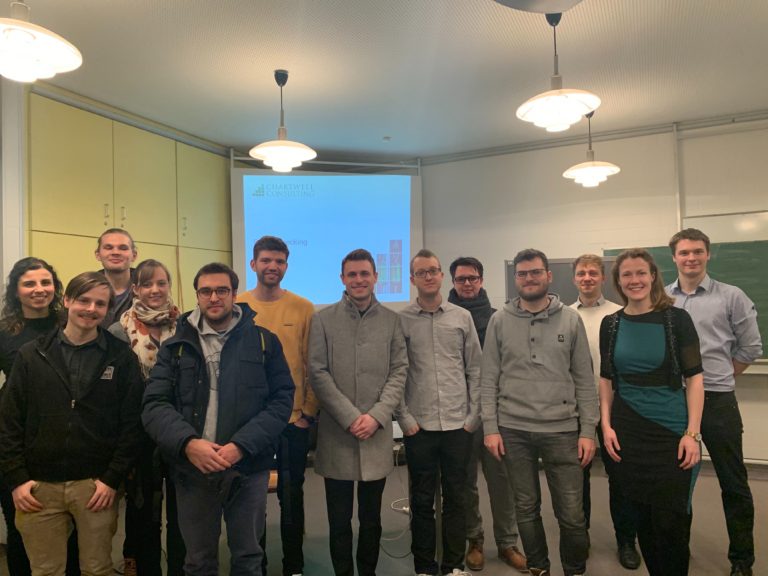
From the 28th of September to the 1st of October, I, Angélica Loría Cárdenas, together with three fellow students from the Technical University of Munich and fellow members of ISPE’s Student Chapter, was cordially invited to attend the 2026 ISPE Robotics & AI and RAYA Conference, which took place in Zurich, Switzerland. As a Master’s student in Pharmaceutical Bioprocess Engineering, this was a great opportunity to gain insights into the newest technologies involved in pharmaceutical operations and the automation of workflows. In the following text, I will explain a bit more about the sponsors involved in this year’s conference.
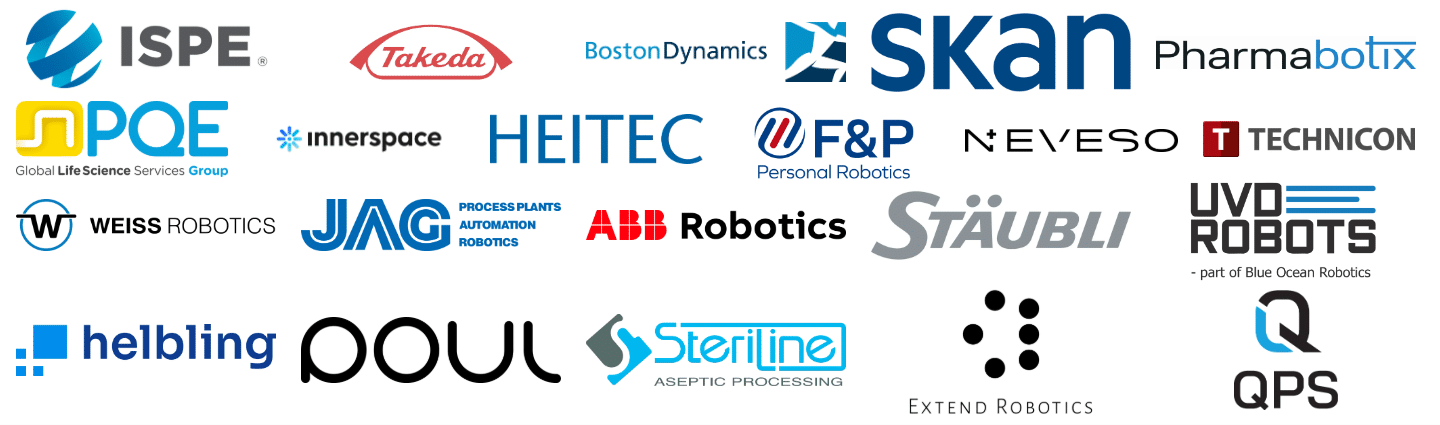
A central part of the conference was the exhibition and the pitches, in which the sponsor companies had the chance to present their newest projects. The host company of the conference was Takeda. This Japanese company has established a very strong presence in the European market over the last few decades. In collaboration with another Japanese company, OryLab, they exhibited OriHime, a robot designed to enable people with disabilities to participate in social and professional activities remotely, without the use of artificial intelligence. In a pharmaceutical manufacturing environment, OriHime can, for example, allow former employees who are no longer able to be physically present after an accident or illness to return to the workplace, whether in the areas of Operations, R&D, or Quality Management. Furthermore, it can also open new opportunities for people with disabilities to participate in the pharmaceutical industry. This concept has already been implemented in practice, making the story behind OriHime particularly moving. Its focus was different from that of the other companies, taking a direct approach to people rather than to pharmaceuticals themselves. This made it a well-deserved recipient of the Gold Medal for the RAYA Public Award.
In terms of the application of robotics and AI in pharmaceuticals, one of the most promising applications exhibited at the conference was their use in cleanrooms. Cleanrooms present many challenges, since there are strict GMP regulations that need to be fulfilled in order to minimize risks during production. The Danish company Poul presents a solution: hygienic mobile robots able to transport heavy loads while implementing a GAMP 5-compliant logistics system. This start-up presents a robot that could be implemented in cleanrooms of Grades C and D, substantially reducing risks for operators.
HEITEC is another company that follows the same goal as Poul, which is to facilitate operations in cleanrooms. Their approach, however, is different. They also implement a mobile robot, but this one has interchangeable modules, with each module serving a different purpose. Most notable is the environmental monitoring module, which is able to measure the parameters of the cleanroom and thus assist with data acquisition and documentation.
Another trend was the utilization of robots to complete tasks that would otherwise be highly monotonous or difficult for operators to perform with consistent results due to the repetitive workload. To address this problem, several companies presented their robotic solutions. Steriline presented the Intelligent Compounding System, which performs aseptic filling in an isolator. By using this system, there is no need to fill the products manually, as two robots are put in place to take care of this process. There is also full traceability of the materials used during the filling of delicate products. When performed manually, this task involves a heavy mental workload, making consistent results difficult to achieve over time.
Another example was presented by Körber and ESSERT Robotics, which introduced a robotic platform that performs visual inspection of prefilled syringes, cartridges, and vials. This allows for a more accurate inspection of the products and greatly reduces the number of personnel that would otherwise be needed for manual work. Similarly, QPS Engineering AG presented an AI-capable inspection system that can differentiate between a defective product and a functioning one, with the added benefit of high repeatability and the ability to collect data.
F&P Robotics presented its mobile robots. They developed Lio, a mobile robot that is able to transport products between laboratory stations and therefore further assist with the workflow of a process. This allows an already existing laboratory to continue operating, since the mobile robot can move from station to station without the need to adapt the entire laboratory to a robotic cell. Another robot was Sola, which integrates AI. There are still many challenges associated with the integration of physical AI into laboratories; however, this appears to be a step in the right direction. Sola can assist in already existing workflows thanks to the integration of AI. This allows for a smoother workflow, since the robot is able to react and solve problems when needed.
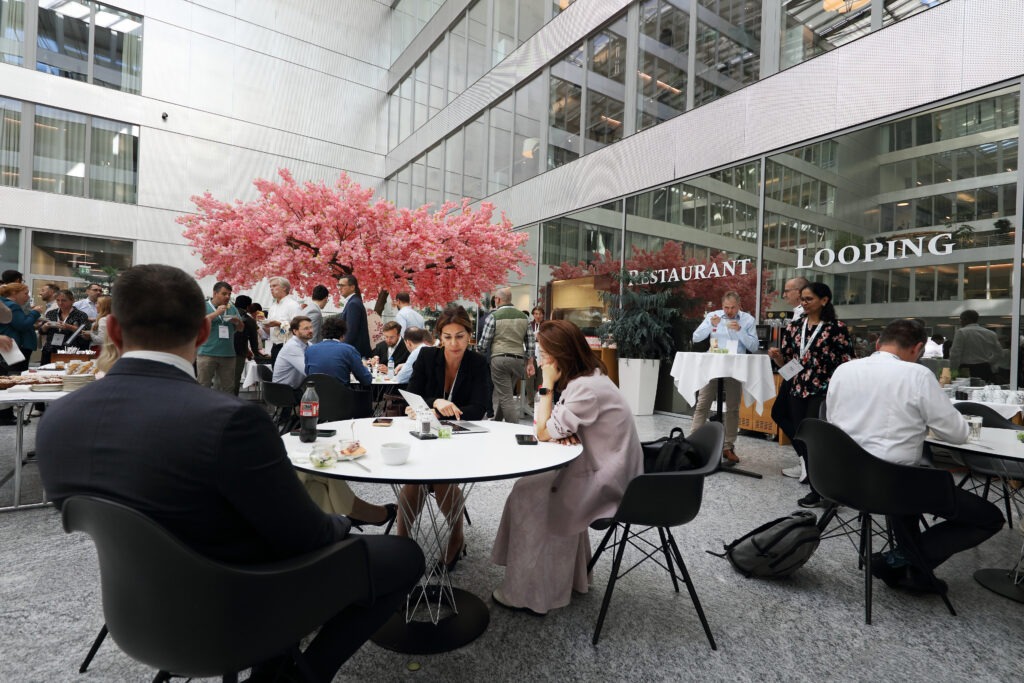
Another example of AI integration was presented by Atinary and ABB Robotics, combining AI with robotics to handle vials, tubes, and plates in laboratory workflows. Moreover, Gluth Systemtechnik and Fraunhofer IPA explore the use of Physical AI to clean pharmaceutical manufacturing components in a fully automated way. AI enables the robot to identify which part requires cleaning and retrieve the necessary information to complete the task. This shows that AI can also assess which tasks require assistance and act accordingly.
Automation of entire workflows was also a central focus throughout the conference. Here, the focus goes beyond individual robots and their reliable but single-purpose applications, as automation relies on a system that is able to complete a process without manual intervention. Following the same approach as the companies discussed previously, Technicon goes a step further and introduces the automation of filling and inspection processes. The robots used in this system are from the company Stäubli, and they can be utilized individually or integrated into the overall system.
The same automation concept was presented by JAG Robotics, implementing automation and robotic logistics into an operating laboratory. The robots can be implemented in different laboratory tasks, since they are fully mobile, functioning as individual tools but also as part of an automated system. This demonstrates that robotics and AI can also be implemented in more extensive laboratory-oriented applications and take over repetitive tasks such as pipetting.
Automation can also expand into more complex tasks, such as cell and gene therapy inoculum preparation and the packaging of components used in continuous glucose monitoring sensors. Pharmabotix AG, together with Stäubli Robotics, presented a very impressive project called Sally. It consists of a robotic cell that is able to function completely on its own, with robots handling samples for cell and gene therapy as well as using external equipment, such as centrifuges, during the process. Another interesting project was a three-robot cell consisting of three modules, which was able to connect an injection-molding process directly with robotic downstream handling and packaging for components used in continuous glucose monitoring sensors. This highlights that robotic automation also works well with delicate materials and can create an entire workflow for complicated laboratory procedures.
Every system needs a baseline, and JAG Robotics presented a platform through which robotic cells, collaborative robots, and mobile robots can be monitored and orchestrated. This is ultimately one of the most important parts of the automation process, since there needs to be a strategy behind the logistics of an automated workflow, something that can be achieved with such a platform.
Other companies presented solutions focused on different aspects of robotic integration. Weiss Robotics develops a wide range of robotic grippers for various handling tasks, while Extend Robotics combines humanoid robots with live VR to help train people in incorporating robotics into practical workflows. Neveso, a company based in Lausanne, focuses on automating laboratory processes with mobile robots that can carry out hazardous tasks, helping protect personnel from procedures involving dangerous chemicals or extremely low temperatures.
Finally, there were some presenters who introduced robotic solutions developed to address existing challenges in pharmaceutical manufacturing. A very up-to-date robotic application is the Isobag® Auto presented by Merck. This system introduces environmental monitoring plates into gloveless aseptic manufacturing without manual handling. One advantage of using this system is its full traceability throughout the entire process, which makes it reliable.
Another impressive use of robotics was presented by Helbling Technik and Nortiva Bio: an automated encapsulation system for a complex star-shaped oral dosage form. The resulting system can precisely fold and insert the dosage form into a standard capsule and was specifically developed as a GMP-ready production machine suitable for manufacturing Phase 3 clinical trial material.
Blue Ocean Robotics presented an autonomous UV-C disinfection system designed for GMP cleanrooms and controlled production areas. It is a mobile robot that follows predefined routes and disinfection programs while automatically documenting each cycle, making the process standardized and traceable. It reduces the need for repetitive manual disinfection and chemical disinfectants, since it relies on UV-C light for disinfection. The system has many advantages, as it can improve contamination control while also reducing workload and supporting more sustainable cleanroom operations.
In conclusion, the exhibition helped us link many themes together, from single-purpose robots performing one specific task to entire systems in which robots can automate a complete process. Robotics and AI are, however, still in their initial stages, and there is still much progress to be made. Nevertheless, the conference was an eye-opening experience that made us realize that there is much more to look forward to.