

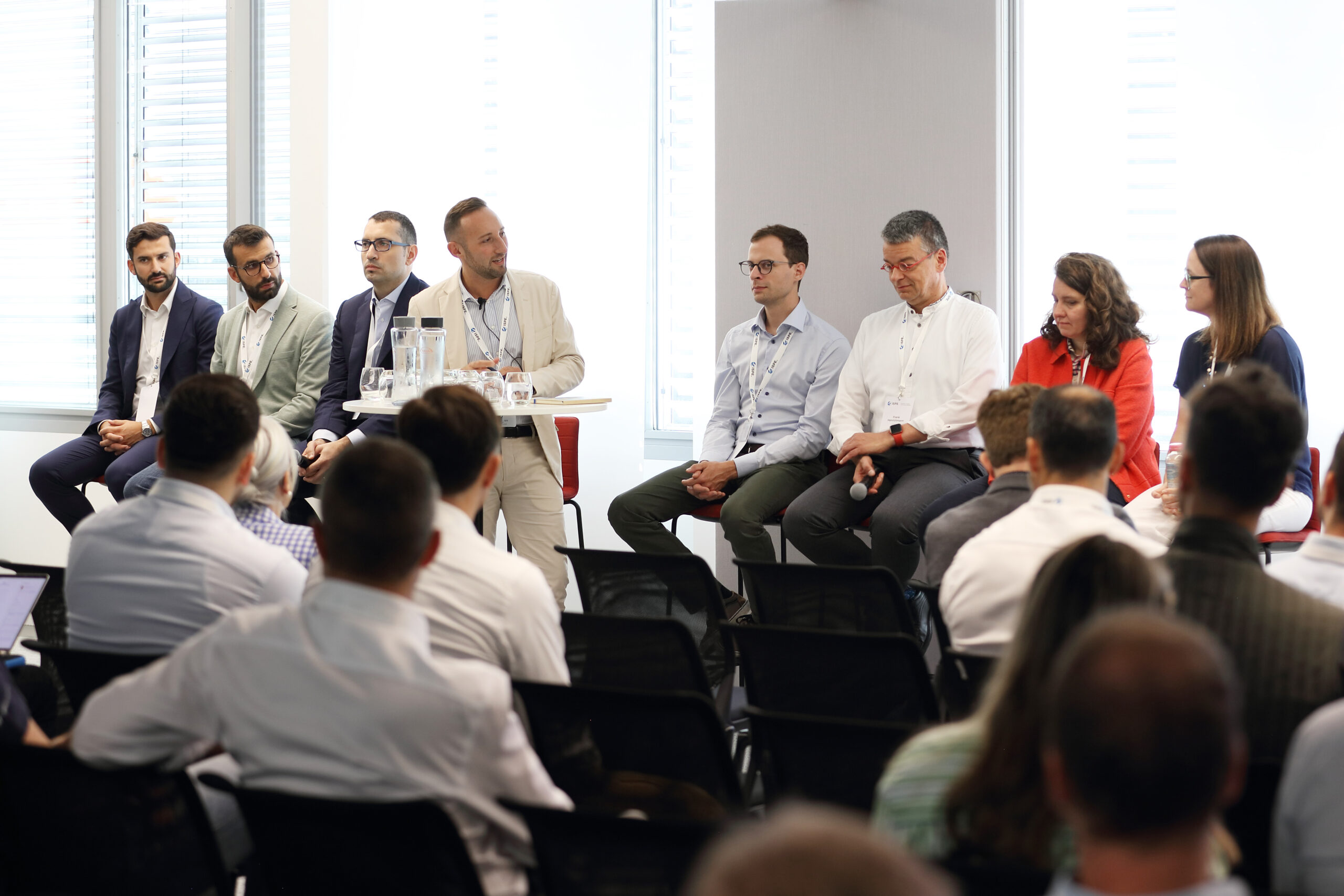
RAYA 2026 – Panel Discussion AI and Robotics
- Post author:Jan Hübner
- Post published:October 13, 2026
- Post category:Article / Events / Future Robotics / RAYA / Review
The conversation around artificial intelligence and robotics in life sciences often swings between distant science fiction and immediate regulatory hesitation. During the AI and Robotics panel discussion at the ISPE Robotics and AI and RAYA event, moderated by Thomas Carganico of ISPE Italy, the focus stayed on practical manufacturing realities. The discussion centered on how pharmaceutical companies can move past conceptual hype to implement intelligent automation on the production floor safely and effectively.
Compliance is often perceived as the primary barrier, but the regulatory foundation may already be stronger than many assume. Sina Berndl of Swissmedic emphasized that existing frameworks such as Annex 11 provide meaningful direction if teams anticipate operational challenges early in the design stage. In this view, risk assessments serve as practical diagnostic tools to expose internal vulnerabilities rather than administrative hurdles. That governance framework must also account for the data feeding of these systems. As Luca Zanotti Fragonara of PQE Group pointed out, realizing business value requires establishing measurable statistical metrics across software environments. Berndl echoed the importance of data integrity, warning that manufacturing facilities hold varied tiers of information, and that unvalidated non-GMP data cannot simply be pooled into model training sets without clear controls.
The regulatory effort behind these standards is demanding, as Christina Meisser of AGES noted when reflecting the detailed commentary and review cycles involved in drafting.
Annex 22 on visual inspection. While human inspection naturally fluctuates from day to day, automated inspection offers repeatability and scalable consistency. The challenge lies in managing new forms of operational risk. Frank Henrichmann of Gamp AI observed that every deployment carries distinct variables, meaning organizations must construct tailored toolboxes of technical safeguards. Henrichmann cautioned against subtle psychological traps, noting that as an algorithm begins consistently producing expected outputs, operators can develop a false sense of security. To counter this complacency, Berndl suggested intentionally supplying incorrect data to test both the software and the vigilance of the human operator. Keeping humans in the loop remains indispensable because automated models cannot foresee every operational edge case, nor can off the shelf architectures easily explain why a specific decision was reached.
For Henrichmann, technical design should originate from patient safety rather than superficial compliance checkboxes, arguing that robust engineering focused on patient wellbeing will naturally satisfy regulatory scrutiny. Translating this philosophy into physical machinery presents its own hurdles. Adam Wolf of Takeda highlighted that while modern manufacturing depends on deterministic, highly proven machinery, advanced robotics often introduce probabilistic variables through dynamic path planning. Wolf advocated for a measured, phased rollout that matches regulatory progress. Highly articulated humanoid systems present far greater complexity than standard automation. Until facilities redesign workspaces with clearly bounded barriers to isolate early-stage failures and resolve lingering risks like particulate contamination, general purpose humanoids remain a difficult fit for cleanrooms.
This distinction between single purpose mechanisms and multifaceted humanoids formed a central theme for Andrea Tanzini of Rahm. Tanzini argued that deploying complex humanoids just to mimic human workers adds friction without sufficient return unless there is a concrete leap in contamination control or ergonomic safety. Instead, dedicated, purpose-built robotic arms executing a single task with high repeatability to offer greater process robustness, even if pure operating speed appears modest. Measurable movement and defined parameters yield reliable validation, whereas versatile systems introduce unpredictability into sterile operations.
Navigating these tradeoffs requires strategic adaptability rather than rigid long-term roadmaps. Sebastiano di Luozzo of H-Farm emphasized that while organizations cannot predict the future with absolute certainty, they can build the capability to adapt alongside emerging tools. In forward looking setups, digital software agents and physical automation will likely collaborate, yet leadership must continually evaluate whether artificial intelligence is genuinely the best answer or merely an attractive distraction. Anticipating systemic blind spots is essential, as di Luozzo warned that “the bullet that kills you is the one you don’t see.” Preparing for that uncertainty demands making sound operational choices even with incomplete data. As Carganico and Wolf summarized in their closing thoughts, mastering this transformation requires active, sustained collaboration between internal engineering teams and external partners.